Inside Wat Phra That Doi Suthep: Every Shrine, Chedi and Viewpoint
Short answer. The terrace at Wat Phra That Doi Suthep is a walled rectangle with the gilded chedi at its centre, two shrine halls east and west of it, a cloister of Buddha images round the outside and a viewpoint on the city side. Walk it clockwise, in that order, and an hour is enough. The bell row, the white elephant shrine and the murals are the three things most visitors walk straight past.
Most descriptions of Doi Suthep stop at "golden temple with a view". The terrace is denser than that, and knowing what you are looking at turns a photo stop into an hour worth having. This is the terrace building by building, in the order the layout actually wants you to walk it. The founding story and the history sit on Wat Phra That Doi Suthep; this is what you see when you get there.
How the terrace is laid out
You arrive at the top of the staircase, or out of the funicular, on the lower level. Shoes stay on here. A second short flight brings you to the upper terrace, the walled rectangle that holds the chedi, and shoes come off before you step onto it.
Inside the wall the plan is symmetrical: chedi in the middle, a viharn on the east side and another on the west, a covered cloister running the whole way round, and Buddha images lining the inner face of that cloister. Everything else — bells, shrines, the model, the offering stalls — sits in the corners.
The chedi, and the three circuits
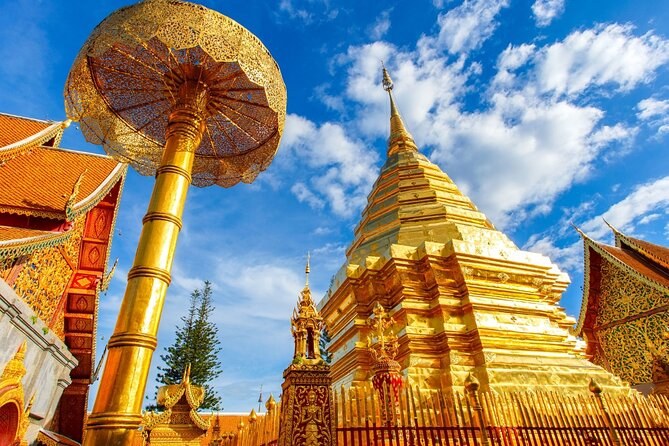
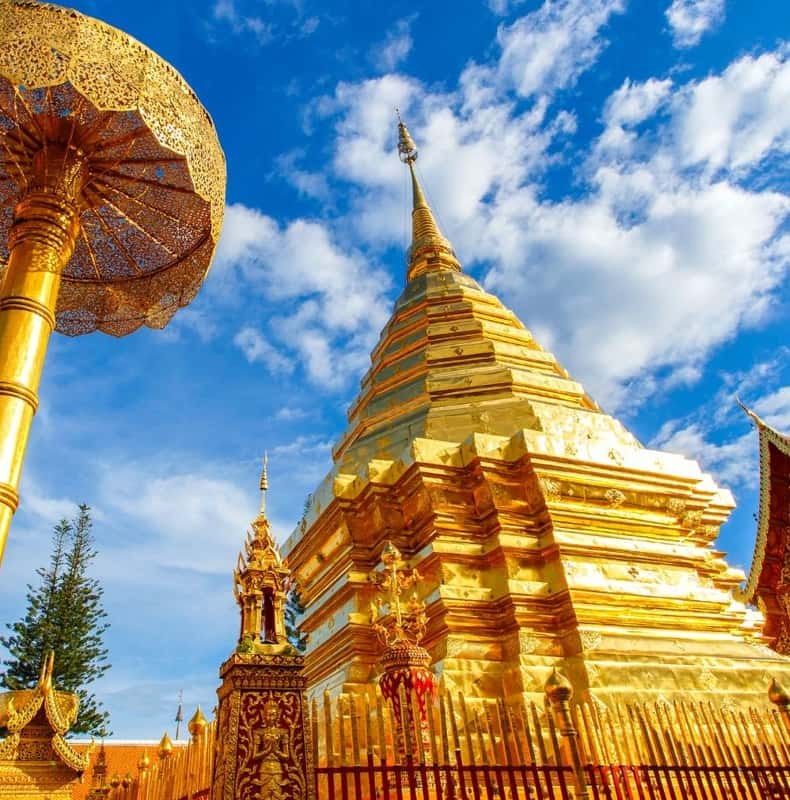
The stupa is 24 metres tall, square-based, stepped and sheathed in gilded copper, with a five-tiered honorific umbrella at the top and four smaller umbrellas at the corners. The relic said to be the Buddha's shoulder bone is sealed inside, which is why the building is the object rather than a container to enter.
The circuit is three times clockwise with your right shoulder toward the stupa, usually carrying a lotus bud, a candle and three incense sticks bought at the stall in the cloister. Nobody minds if you simply walk it, and nobody minds if you join in properly either.
The eastern viharn
The older-feeling of the two halls: dim, heavy with gold leaf and glass mosaic, with a principal Buddha image at the far end and rows of smaller images down both walls. This is where the morning and evening chanting happens, and where you sit if you want to be present for it.
Shoes off at the door, feet tucked behind you rather than pointed at the images, and photographs are fine as long as you are not standing between somebody and what they came to do.
The western viharn and the emerald Buddha replica
Lighter, and busier on holy days. It holds a green Buddha image modelled on the Emerald Buddha in Bangkok, and there is often a short queue in front of it. The murals along the side walls here are more recent than the ones in the cloister and easier to read.
The cloister and its Buddha images
The covered walkway round the inside of the wall is the part people photograph without looking at. Along its inner face is a continuous row of Buddha images, seated and standing, in postures that repeat around the rectangle. Above them, in stretches, are painted panels of scenes from the Buddha's life.
It is also the coolest part of the terrace and the place to be at midday, which is worth knowing if the middle of the day is when you arrive.
Two other monasteries turn up on almost every itinerary that includes this one, and neither looks anything like it. Wat Pha Lat is a forest monastery halfway down the mountain; Wat Umong is a tunnelled mound at the bottom. Seeing one of them the same day is what stops a temple visit feeling like a single photograph.
The bell row
Along one stretch of the cloister wall hangs a line of bronze bells of ascending size. Striking each one once, in order, walking as you go, is a merit-making circuit rather than a photo opportunity, and Thai visitors do it briskly and without ceremony. Join in and nobody will look twice.
The white elephant shrine
Near the top of the staircase stands a statue of a white elephant, marking the animal that carried the relic up the mountain in 1383, trumpeted three times, knelt and died where the chedi now stands. Offerings are still left here, and it is the one piece of the site that explains why the temple is where it is rather than somewhere more convenient.
The viewpoint terrace
Reached through the western side of the wall, a separate open terrace looks east over the whole Chiang Mai grid, the Ping valley and the mountains beyond. In the cool season the city is sharp from here; in March the smoke can hide it completely.
Go to the viewpoint first if you arrive after nine. It is the one part of the terrace that fills up and stays full, and it is five minutes' work early and twenty minutes' patience later. When it is clearest, month by month, is in Doi Suthep month by month.
What most visitors walk past
| What | Where | Why it is worth two minutes |
|---|---|---|
| The bell row | Cloister wall | A merit circuit you can join, not an exhibit |
| The temple model | Near the eastern viharn | Shows the whole layout at a glance |
| The cloister murals | Above the Buddha images | The Buddha's life, panel by panel |
| The white elephant | Top of the staircase | The reason the temple is here at all |
| The monks' Q&A | On the terrace, set hours | Open to anyone, in English, no pressure |
The route to walk, in order
- Up the staircase, pausing at the white elephant shrine.
- Shoes off, onto the upper terrace, and straight to the chedi.
- Three circuits clockwise, offering placed on the eastern face.
- The eastern viharn, then the western one.
- The cloister, slowly, for the images, the murals and the bells.
- The viewpoint terrace last, unless you arrived after nine.
An hour does all of that without hurrying. If you want the chanting as well, add another. Which departures give you that long is compared on plan your visit.
Etiquette that matters, briefly
- Shoulders and knees covered on the upper terrace, everyone.
- Shoes off before the terrace and again at each hall door.
- Never turn your back on a Buddha image to pose for a photograph.
- Women do not hand anything directly to a monk; put it down and he will pick it up.
- Sit with your feet behind you rather than crossed in front.
When each part of the terrace is busiest
The upper terrace fills unevenly. The viewpoint is the first thing to crowd and the last to clear, because it is the one part everybody has seen a photograph of. The cloister is almost always walkable, and the eastern viharn empties between the two chanting sessions.
Coaches arrive from mid-morning and thin out after three. If you are on the terrace between ten and three, walk the cloister first, take the chedi circuits second and leave the viewpoint until the group ahead of you has moved on. The hour-by-hour picture is on plan your visit.
If you only have twenty minutes
It happens: a shared departure with a tight schedule, or a driver waiting at the bottom of the stairs. Twenty minutes is enough for a real visit if you spend it in the right order.
- Straight up, shoes off, and one clockwise circuit of the chedi.
- Two minutes inside the eastern viharn, sitting rather than standing.
- The bell row on the way round, striking as you walk.
- The viewpoint for the last five, and back down the stairs.
What you lose is the second hall, the murals and any chance of the chanting. What you keep is the part that makes the place a temple rather than a lookout. If that sounds thin, the departures that allow two hours are compared on the Doi Suthep tours FAQs and on how to visit Doi Suthep.
Where the photographs come from
Almost every image of this temple is one of four frames: the chedi against open sky from the north-west corner, the naga heads at the foot of the staircase, the row of gold images along the cloister, and the valley from the viewpoint. Seeing them in the Doi Suthep gallery before you go is a quick way to work out which part of the terrace you actually care about.
Now you know what to look at, pick the hour to see it in on Doi Suthep Tours.
Tours that fit this trip
Chosen for what this post covers, not for what sells.