Doi Suthep Ticket Prices and Fees, Charge by Charge
In this guide
- What does it cost to stand in front of the chedi?
- Why do sources disagree about 30 and 50 baht?
- What is the funicular, and is it worth 20 baht?
- What is the national park fee, and when did it start?
- Which places does the park fee actually cover?
- Who pays nothing at all?
- What does Bhubing Palace add?
- What does the ride up cost?
- What does a guided tour cost, by format?
- Which fares have already settled the fees?
- How much cash should you carry?
- What are you not obliged to pay for?
- What does a family of four spend in a day?
What does it cost to stand in front of the chedi?
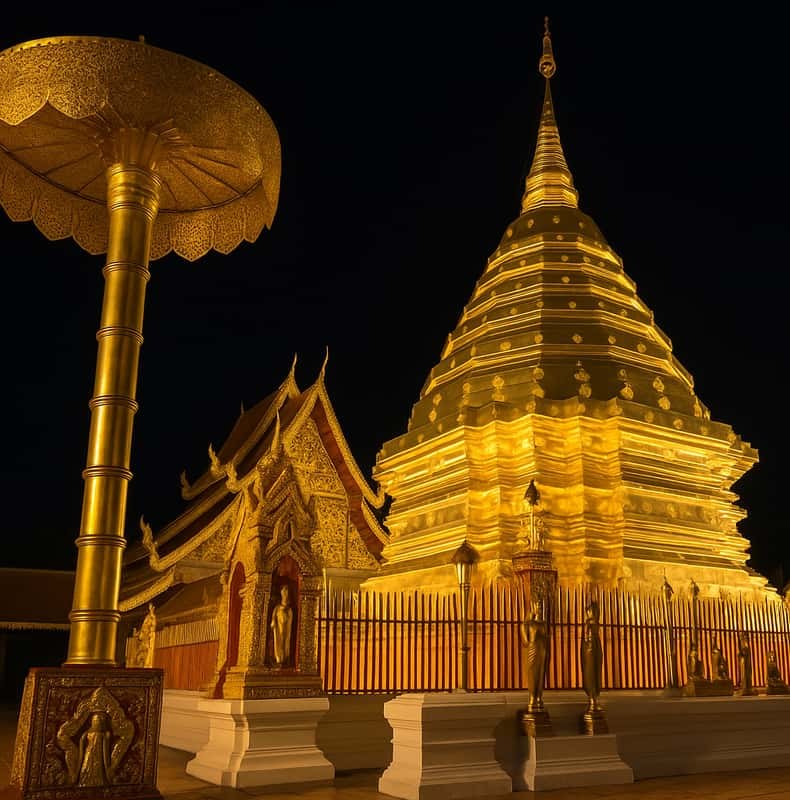
Thirty baht, for a foreign visitor, collected in cash at the top of the staircase. Thai nationals are not charged. That is the whole admission to Wat Phra That Doi Suthep, and it is roughly the price of a bottle of water in the old city.
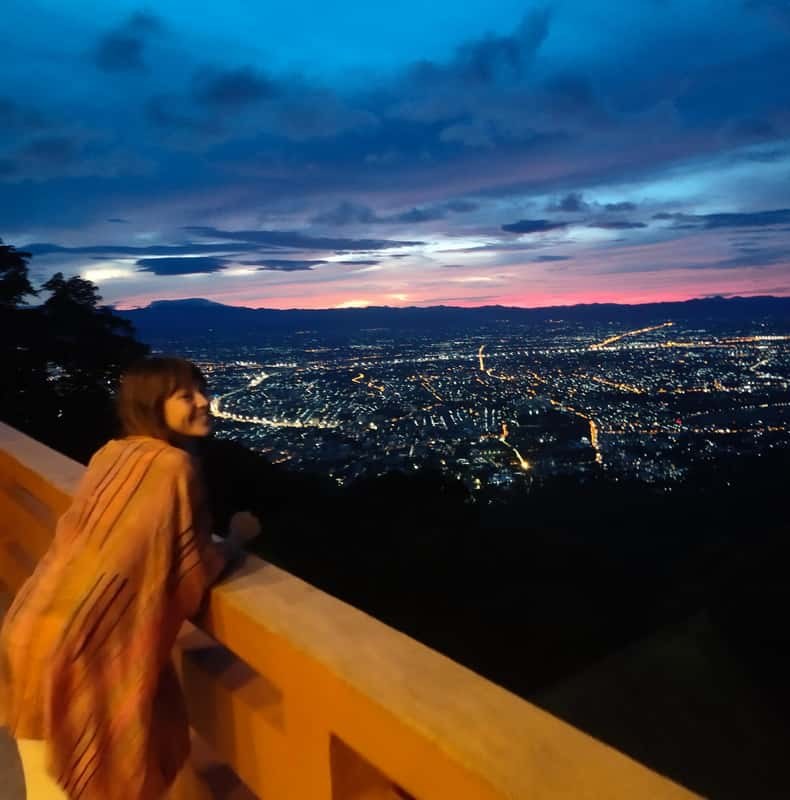
It buys the terrace, both shrine halls, the cloister and the viewpoint. There is no premium ticket, no timed entry and no queue for it. Everything else you spend on this mountain is transport, the funicular, the national park, or something you chose to buy.
Why do sources disagree about 30 and 50 baht?
Because both figures appear in print. Travel guides published in 2025 give 30, and four of the tour listings for this mountain state 50 as the temple charge inside their inclusion lists. One states 30, bundled with the funicular.
Carry 50 and the question stops mattering. The gap is twenty baht — well under a dollar — and it only bites if you arrive with exact change. Where a fare includes the charge, the operator settles it either way and you never see the number.
We publish 30 as the figure, note that some operators collect 50, and leave the disagreement visible rather than resolving it in whichever direction reads better. If you find it has settled, the correction form is on the contact page.
What is the funicular, and is it worth 20 baht?
A short cable railway running up the hillside beside the naga staircase, arriving on the terrace itself. Twenty baht each way, about a minute, and it is the reason the temple works for visitors who cannot manage 309 steps.
Worth it in one direction for almost everyone: stairs up for the arrival, cable car down for the knees. Worth it in both directions in the middle of a hot afternoon, or with small children, or if you are carrying camera gear. Guides wait at the top for whoever takes it, so it never splits a group.
What is the national park fee, and when did it start?
Doi Suthep-Pui National Park began charging on 1 October 2025. A foreign adult pays 100 baht and a foreign child 50; Thai nationals pay 20 and 10. A share of the revenue is returned to the communities around the park and a share funds the department that manages it.
This is the newest charge on the mountain and the one most likely to be missing from a guidebook, a blog post or a friend's advice. It is also the one that catches walkers specifically, which makes it feel arbitrary until you see where it applies.
Which places does the park fee actually cover?
| Place | Park fee | Other charges |
|---|---|---|
| Pha Lat Nature Trail (Monk's Trail) | THB 100 adult / 50 child | None |
| Huai Kaew Waterfall | THB 100 adult / 50 child | None |
| Wang Bua Ban and Pha Ngoap waterfalls | THB 100 adult / 50 child | None |
| Doi Pui and Suan Son | THB 100 adult / 50 child | Village entry, if charged |
| Wat Phra That Doi Suthep by road | None | THB 30 terrace, THB 20 funicular |
| Wat Pha Lat by road | None | None |
| Bhubing Palace | None | About THB 50 |
The pattern is walkers and forest, not temples. Reach the temple or Wat Pha Lat on the sealed road and the park never appears; step onto the trail or into a waterfall and it does. The detail and the source are on the national park page.
Who pays nothing at all?
Thai nationals at the temple. Children under three on most tour fares. And anyone whose whole visit is the temple by road, arriving on a fare that already includes the terrace charge — which is most guided departures.
Monks and novices are not charged anywhere on the mountain, and neither are people attending a religious observance rather than visiting. On the big full-moon days the terrace fills with Thai families and almost nobody is paying anything.
What does Bhubing Palace add?
About 50 baht and an hour at Bhubing Palace, plus a stricter dress code than the temple's: no shorts, no sleeveless tops, trousers hireable at the gate. The gardens are the attraction, and they are unusual for the latitude — roses and cool-climate planting at 1,300 metres.
The catch is that the grounds close to visitors when the royal family is in residence, on dates that move each year. Nobody should build a day around it without checking on the morning, and no shared departure includes it for exactly that reason.
What does the ride up cost?
A shared red songthaew runs 40 to 50 baht a person each way when full, and about 70 to carry on to the palace. A chartered truck with waiting time runs into several hundred baht for the round trip. A Grab costs several times the shared fare and may be hard to find for the return.
Against that, the cheapest guided departure on this mountain covers the return drive, three stops and a fixed departure time. Once two people are travelling, the gap between doing it yourself and booking a seat is smaller than it looks — the arithmetic is worked through in going to Doi Suthep independently.
What does a guided tour cost, by format?
Sorted by fare, with the column that tells you whether the gate charges are already handled.
| Tour | Fare | Fees included | Total hours | On the terrace |
|---|---|---|---|---|
| Chiang Mai: Doi Suthep & Wat Pha Lat by Local Red Truck | From $17 | No | 4 hours | 1 hour |
| Chiang Mai: Wat Pha Lat & Wat Phra That Doi Suthep Tour | From $22 | Yes | 4.5 hours | — |
| Chiang Mai: Doi Suthep and Wat Umong Enchanting Evening Tour | From $22 | Yes | 5 hours | 1 hour |
| Chiang Mai - Doi Suthep Temple & Wat Pha Lat Hike | From $24 | No | 4 hours | — |
| Chiang Mai - Doi Suthep Temple & Wat Pha Lat Hike | From $24 | No | 4 hours | 2 hours |
| Chiang Mai: Doi Suthep, Wat Umong and Pha Lat Sunrise Tour | From $25 | Yes | 4 hours | 2 hours |
| Chiang Mai Best City Tour with Doi Suthep, Pha Lat & Chedi Luang | From $40 | Yes | 4 to 6 hours | 30 minutes |
| Spiritual Sunrise Wat Doi Suthep, Pha Lat, Alms & Meditation | From $55 | Yes | 5.5 hours | 1 hour 30 minutes |
| Doi Suthep Temple, Pha Lat Temple, Sticky Waterfall, Orchid farm | From $78 | Yes | 8 to 9 hours | 1 hour 30 minutes |
| Doi Suthep Temple, Wat Phalad, BauThong Waterfalls Private Tour | From $109 | Yes | 7 to 9 hours | 1 hour |
| Chiang Mai Instagram Tour: Most Famous Spots (Private and All-Inclusive) | From $121 | Yes | 6 to 8 hours | 45 minutes |
| Private Chiang Mai Temple Tour with Doi Suthep and Wat Umong | From $137 | Yes | 9 hours | 1 hour |
Two things stand out. The gap between the cheapest and the most expensive shared departure is about ten dollars, which is less than the difference an hour of the day makes. And the private days are a different product rather than a premium version of the same one.
Which fares have already settled the fees?
Most guided departures include the temple charge, and the evening departures name the exact amounts — the two that also stop at Wat Umong cover its 20-baht gate as well. The walking departures generally do not, because they also attract the park fee, and they say so plainly and ask for cash on the day. The unguided ride includes the ride and nothing else, which is why it is the cheapest thing on the mountain.
One sunrise departure includes every admission its programme needs, which for a 5 a.m. start with three temples is worth more than the money: you are not counting notes in the dark at a gate.
How much cash should you carry?
Two hundred baht a person covers a guided visit comfortably: offerings, a drink, and the funicular if you take it. Four hundred covers an independent day with the songthaew both ways, the terrace, the funicular and lunch at the stalls.
Add a hundred a person if your day includes the trail, a waterfall or the summit village. There is no cash machine on the mountain, card acceptance is limited to nothing, and small notes are much easier to spend than a thousand-baht bill at half past five in the morning.
What are you not obliged to pay for?
Two things get presented as expected and are not. The first is a donation at the shrine tables: offerings are voluntary, the amounts are personal, and nobody is watching. The second is a photograph with someone in traditional dress near the car park, which is a commercial service and priced accordingly.
The offering set from the cloister stall — lotus, candle, three incense sticks — costs very little and is the one small purchase worth making, because it is what turns the three circuits from a walk into the thing everyone else is doing.
Nothing on the terrace is upsold, there is no audio guide to rent, and there is no premium ticket. If a fare covers the temple charge, the only money you need inside the wall is whatever you choose to spend.
What does a family of four spend in a day?
Independently: about 400 baht on transport for the group in shared trucks, 120 on the terrace for two adults and two children, 80 on the funicular if everyone rides it, and whatever lunch costs at the stalls. Call it 700 to 900 baht for the day.
On a guided departure, four seats on a shared evening tour with fees included, plus a little cash for offerings. On a private day, one fare covering the vehicle, the guide, lunch and admissions — which for four people is often the better arithmetic, and always the easier day.
Common questions
How much is the Doi Suthep entrance fee?
Thirty baht for foreign visitors at the terrace gate, with some operators quoting 50. Thai nationals are not charged. The funicular is a separate 20 baht each way.
Is there a fee for the national park?
Yes, since 1 October 2025: 100 baht for a foreign adult and 50 for a child, on the trail, the waterfalls and Doi Pui. Not on the road to either temple.
Can I pay by card at the temple?
No. The terrace charge, the funicular and the stalls are all cash, and there is no machine on the mountain.
Do tour prices include the entrance fee?
Most guided departures include the temple charge; the walking departures usually do not, because the park fee applies as well. Each card names the fees its fare covers.