Doi Suthep Month by Month: Weather, Haze and Festival Dates
In this guide
- When is the view from Doi Suthep actually clear?
- What is burning season, and how bad is it?
- What does the rainy season really mean up there?
- How cold is a December sunrise?
- Which month is busiest on the terrace?
- What happens at the temple on Visakha Bucha?
- Is Loy Krathong a good week to come?
- Does Songkran change anything up here?
- What is the best time of day, month by month?
- When do the sunrise departures sell out?
- What should you pack, by season?
- What does the wet season give you that the cool season does not?
- Which dates fill the terrace, and should you avoid them?
- Which month would you choose?
When is the view from Doi Suthep actually clear?
November to February, reliably. The rains have washed the air, the burning has not started, and on a good morning the whole Chiang Mai grid is sharp from the viewpoint with the mountains beyond it visible.
The rest of the year splits into two problems. March and April bring agricultural smoke that can hide the city completely. May to October brings cloud and rain, which is a different thing entirely: the air is clean and the view comes and goes with the weather rather than being absent for weeks.
What is burning season, and how bad is it?
Northern Thailand burns crop residue between roughly late February and April, and the valley traps the smoke. In a bad week the air quality in Chiang Mai is among the worst recorded anywhere, and from the temple viewpoint the city is a pale suggestion rather than a view.
It does not close anything. The temple, the chanting, the chedi, the cloister and both shrine halls are unaffected, and the forest lower down is more comfortable than the terrace. If you are travelling in March, plan the mountain as a temple visit rather than a viewpoint visit and the trip holds up.
March and April are the months to go at dawn or after dark. Early morning is the cleanest air of the day, and after sunset the city is a field of lights, which does not care about haze. The two windows are compared in sunrise or evening at Doi Suthep.
What does the rainy season really mean up there?
Heavy showers rather than all-day drizzle, usually in the afternoon, and a mountain that is greener than at any other time of year. The temple has covered cloister on all four sides, so a downpour is a twenty-minute pause rather than a ruined visit.
What it changes is the walking. The Monk's Trail turns slick where it crosses rock and roots, and the guided walks carry on regardless because tropical showers pass — a poncho in the bag is the whole solution. The trail conditions are on the Monk's Trail.
How cold is a December sunrise?
Cold enough to want a jacket, which surprises people who have packed for Thailand. The terrace sits about 1,070 metres up and runs several degrees below the valley floor, and at half past five in December that can mean single figures.
It is also the best light of the year, with mist filling the valley below the terrace and lifting as the sun comes up behind the city. Two layers and the discomfort disappears; the sunrise departures all note it and none of them provide the jacket.
Which month is busiest on the terrace?
December and January, by a distance, when the cool season brings both international visitors and Thai holidaymakers. Add the New Year period and the terrace at midday is as full as it gets.
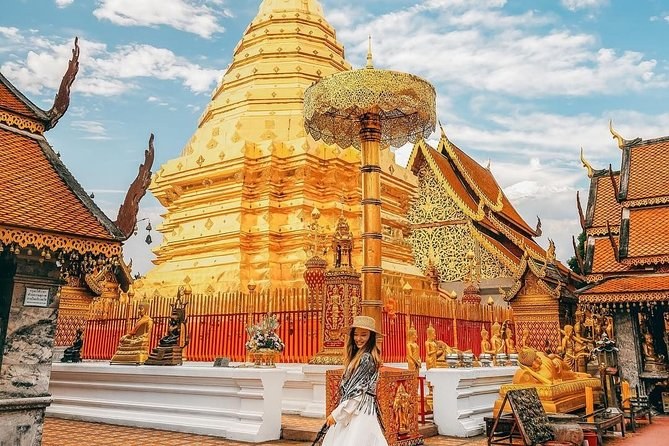
The counter-intuitive part is that this barely matters if you go at the right hour. A December sunrise is quieter than an August lunchtime, because the crowd is a function of the clock rather than the calendar. The hourly pattern is in the timetable on plan your visit.
What happens at the temple on Visakha Bucha?
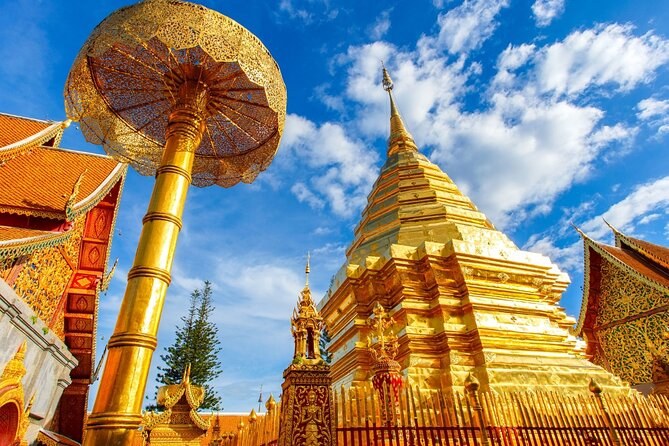
Visakha Bucha, on the full moon of the sixth lunar month, is the most important day in the Thai Buddhist year, and at this temple it produces something visitors rarely see: candlelit processions circling the chedi after dark, three times, with thousands of people taking part.
Some pilgrims walk the mountain road from the city through the night to arrive for it. It is not a performance and it is not ticketed, and if your trip coincides with it, it is the single most memorable evening on offer here. One traveller's review of a walking departure records arriving on the Buddha's birthday to find 800 monks on the terrace.
Is Loy Krathong a good week to come?
For Chiang Mai, yes, unreservedly — it is the city at its best. For the temple specifically, it is a busy week rather than a special one, since the lanterns and the floating offerings happen on the river and around the old city rather than on the mountain.
Book earlier than usual if your trip falls in that week. Accommodation and tours across the city fill, and the small-group departures here go first. The dates move with the lunar calendar and usually fall in November.
Does Songkran change anything up here?
Mid-April, and the honest answer is that the mountain is a relief from it. The water fighting is a city phenomenon; the temple is a place of observance where people come to bathe Buddha images and make offerings rather than to throw water at strangers.
Practically: expect heavy traffic on the Huay Kaew road, a full car park and a terrace busy with Thai families. Expect also that nobody will soak you inside the temple wall. It is also the tail of burning season, so the view is a lottery.
What is the best time of day, month by month?
| Month | Weather | Haze | Crowds | Best hour |
|---|---|---|---|---|
| November | Dry, cool nights | Clear | Rising | Sunrise |
| December | Coldest of the year | Clear | Highest | Sunrise, with a jacket |
| January | Cool and dry | Clear | High | Sunrise or evening |
| February | Warming | Starting | High | Sunrise |
| March | Hot | Worst | Falling | Dawn, for the air |
| April | Hottest | Bad, easing late | Songkran spike | Evening |
| May | First rains | Clearing fast | Low | Evening |
| June–July | Wet afternoons | Clean | Low | Morning |
| August–September | Wettest | Clean | Lowest | Morning |
| October | Rains ending | Clean | Rising | Sunrise |
The pattern across the whole table: dawn wins nine months of the year, and April is the one month where the evening is clearly the better call.
When do the sunrise departures sell out?
November through February, and over the New Year period they can go a week ahead. The sunrise and walking departures cap at nine and ten travellers, which is a small number against the volume of visitors the cool season brings.
Everything here refunds in full at 24 hours, so booking early in that window costs you nothing and losing the slot costs you the whole reason for the early start. Outside the cool season, a day or two ahead is plenty.
What should you pack, by season?
- November–February. A jacket for dawn, long trousers for the temple, and something warm for the drive back down in an open songthaew.
- March–April. A mask if the air is poor, sun cover for an unshaded terrace, and water. The gilding is hot to the touch by noon.
- May–October. A poncho or small umbrella, shoes with grip if you are walking, and insect repellent for the forest.
- All year. Shoulders and knees covered, cash in small notes, and a layer, because the terrace is always cooler than the city.
What does the wet season give you that the cool season does not?
Space, and a greener mountain. August and September are the quietest months on the terrace by a distance: the coach traffic thins, the small-group departures have room a day ahead, and the forest below is at its most dense.
The air is also clean, which is the thing March cannot offer at any price. Storms arrive in the afternoon and clear, and the light immediately after one is the best of the year for photographs of the chedi against a moving sky.
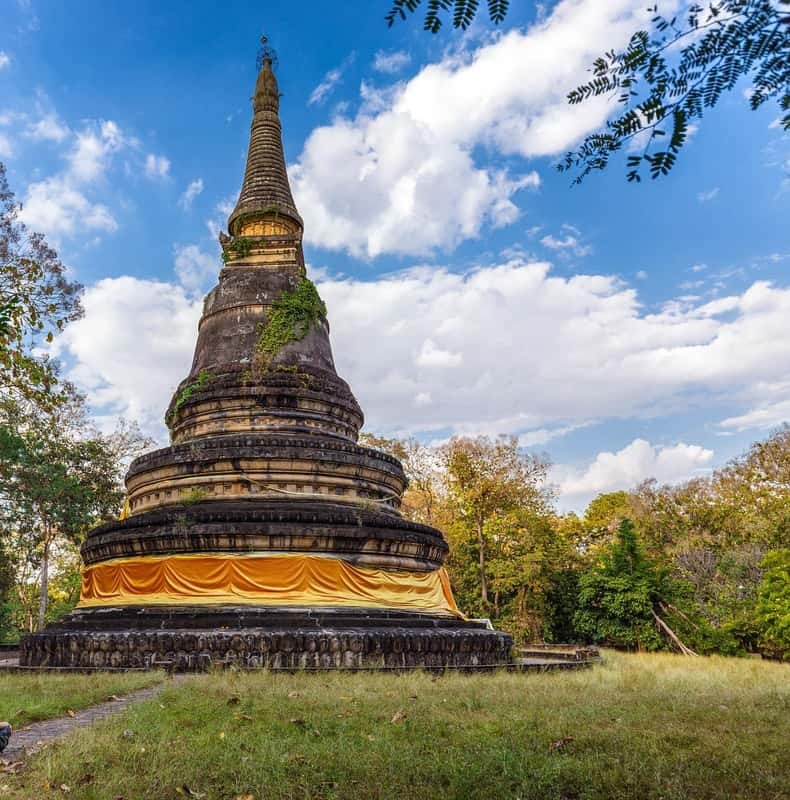
The forest monastery of Wat Pha Lat is at its best in these months: the stream through the grounds actually runs, and the moss on the stonework is green rather than grey. Wat Umong at the foot of the mountain stays dry whatever the sky is doing, which makes it the natural second stop in a wet week.
What you trade is certainty. A wet-season afternoon may be washed out, and the walking trail is slick where it crosses rock. Both are manageable: go in the morning, take a poncho and shoes with grip, and use the covered cloister when a shower arrives. Conditions on the path are on the Monk's Trail, and every departure here refunds in full at 24 hours if the forecast turns against you.
Which dates fill the terrace, and should you avoid them?
Four moments in the year change the mountain. Visakha Bucha, on the full moon of the sixth lunar month, brings candlelit processions round the chedi after dark and pilgrims who walk the road overnight to be there. Magha Bucha and Asalha Bucha do something similar on a smaller scale.
Then there is New Year, when the terrace at midday is as full as it ever gets, and Songkran in mid-April, when the temple is calm and the road to it is not.
None of them is a reason to stay away. A full-moon evening is the most memorable version of this place on offer, and the crowd is part of what makes it so. What they are a reason for is booking earlier and arriving earlier: on those dates the difference between five in the afternoon and seven in the evening is the difference between a terrace and a queue.
Which month would you choose?
Late October or early November. The rains have finished, the air is as clean as it gets, the mountain is still green from the wet season, the cool-season crowds have not arrived, and a sunrise is comfortable rather than cold.
Second choice, and it is close: May. The first rains clear the smoke within a fortnight, the terrace is quiet, the light after a storm is spectacular, and every Doi Suthep half day tour has space. The month with the least to recommend it is March, and even then a dawn visit works — see Doi Suthep Tours for the departures that start before six.
Common questions
What is the best month to visit Doi Suthep?
Late October to February for clear air and the sharpest view. Late October and November combine clean air with green forest and smaller crowds.
Is Doi Suthep worth visiting in burning season?
Yes, as a temple rather than a viewpoint. The chedi, the chanting and the cloister are unaffected; go at dawn or after dark and the haze matters much less.
Does the temple close in the rainy season?
No. The gate keeps the same hours all year, and the cloister runs round all four sides of the terrace, so a shower is a pause rather than a problem.
How cold does it get at the temple?
Several degrees below the city, and a December sunrise can mean single figures. Take a layer for any early or late visit between November and February.