A Half Day on Doi Suthep, Hour by Hour
In this guide
- What fits into a half day on Doi Suthep?
- When should you leave the old city?
- How long is the drive up the mountain?
- What does the first hour on the terrace look like?
- Can you add Wat Pha Lat without adding hours?
- Where does food fit into the day?
- What does an afternoon start change?
- Is Bhubing Palace worth the extra hour?
- How do you get back down?
- What does the full-day version add?
- Is a second temple worth the extra hour?
- What would you drop if you only had three hours?
What fits into a half day on Doi Suthep?
Four to five hours, door to door, is the standard shape of a Doi Suthep half day, and it holds the drive up, one to two hours on the temple terrace, and either a forest monastery below or a tunnel temple at the foot of the mountain. That is the whole envelope, and everything below is how the hours get spent inside it.
What does not fit is the palace and the summit village as well. Those need a vehicle that waits, which in practice means a private car or a chartered songthaew, and they turn a half day into a full one. The options up there are set out on things to do on Doi Suthep.
When should you leave the old city?
There are two good departure windows and one bad one. Leaving between half past four and five puts you on the terrace for the dawn chanting with the mountain to yourself. Leaving between half past three and half past four in the afternoon puts you there as the coaches go and the light turns.
Leaving at nine in the morning puts you into the worst two hours of the day: the road is busy, the car park is full, the funicular has a queue and the terrace is at its most crowded. It is not a wasted trip, but it is the version of Doi Suthep people are politest about afterwards.
The hour matters more than the operator. Two departures with the same itinerary and the same fare produce completely different days depending on whether they leave at five or at nine. The hour is in the timetable on plan your visit.
How long is the drive up the mountain?
Thirty to forty minutes from the old city in normal traffic, and the distance is only 15 kilometres. The time goes on the climb: the Huay Kaew road leaves the city past the university and the zoo, then turns into a sequence of switchbacks that nobody hurries.
Two things happen on that road that are worth knowing about. The first is the Kruba Srivichai monument at the foot of the climb, dedicated to the monk whose volunteers built the road in 1935 — one sunrise departure stops there. The second is a pair of signed viewpoints on the way up, both worth five minutes if your vehicle is yours to stop.
In the wet season the road is fine but slower, and after dark it is a road you would rather not be riding a rented scooter down. That asymmetry is the practical reason evening departures are worth their fare.
What does the first hour on the terrace look like?
You arrive at the car park or at the foot of the staircase, and the first decision is 309 steps or a 20-baht funicular. Either takes less time than choosing.
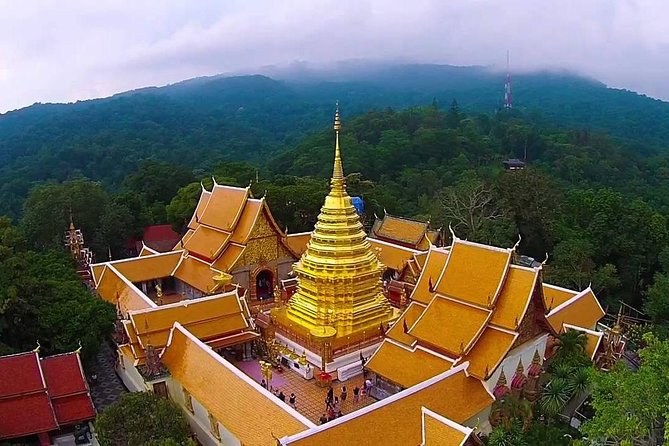
- Minutes 0–5. Up, past the white elephant shrine, shoes off at the edge of the upper terrace.
- Minutes 5–20. The offering set from the cloister stall, then three clockwise circuits of the chedi.
- Minutes 20–35. The eastern viharn, sitting rather than standing, then the western one and its green Buddha.
- Minutes 35–50. The cloister: gold images, the murals above them, and the bell row struck as you walk.
- Minutes 50–60. The viewpoint terrace, and back down.
That is a complete visit. What each of those things is, in detail, is on Wat Phra That Doi Suthep.
Can you add Wat Pha Lat without adding hours?
Yes, if you drive to it and no if you walk. The forest monastery sits below the temple on the same road, ten minutes by vehicle, and a stop of 40 minutes to an hour fits inside a four-hour half day without difficulty. Several departures do exactly that.
Walking to it is a different proposition: 30 to 45 minutes each way on the Monk's Trail, plus the national park's 100-baht charge, which turns the half day into a five-hour one and changes its character completely. That is a good trade if the walk is the point — the route is described on the Monk's Trail — and a poor one if you are trying to fit a temple around a lunch reservation.
Where does food fit into the day?
Nowhere on the terrace, which surprises people. There is no restaurant inside the wall and nothing beyond water for sale up there. The stalls at the foot of the staircase sell noodle soup, grilled skewers, fruit and cold drinks from early morning, and that is the whole catering offer on the mountain until you reach the summit village.
A sunrise departure solves it by building a local breakfast into the way down, usually around eight. An evening departure does not need to solve it, because you eat in the city afterwards. A late-morning trip is the one where you should have eaten first.
What does an afternoon start change?
Everything about the temperature and most things about the crowd. From about four the coach parties are heading down, the terrace stops being a queue, the stone underfoot has stopped being hot, and the light stops flattening the gilding.
It also puts the chanting inside your visit rather than beside it. The evening session begins around six, and a departure that collects you at half past three has you on the terrace comfortably before it starts. The trade is that you lose the mist and the alms round, which are the sunrise's own arguments.
Is Bhubing Palace worth the extra hour?
If you like gardens, yes. Bhubing Palace, the royal winter residence, sits four kilometres beyond the temple in terraced grounds of roses, ferns and cool-climate planting that would not survive in the valley, and entry runs around 50 baht.
Two caveats, both easily handled. The dress code is stricter than the temple's — no shorts, no sleeveless tops, trousers hireable at the gate — and the gardens open to visitors only when the royal family is not in residence, on dates that move. Treat it as a bonus you check on the day rather than the reason for the trip.
How do you get back down?
On a guided departure, in the vehicle you came up in, which is the entire argument for booking one if your visit ends after dark. Independently, it is a shared red songthaew from the car park, and they run until the traffic thins.
The asymmetry is real: at eight in the morning every truck at the bottom is heading into town and the fare is whatever the sign says. At eight at night the trucks have thinned out and the fare becomes a negotiation on a dark mountain road. Rates and last realistic times are in going to Doi Suthep independently.
What does the full-day version add?
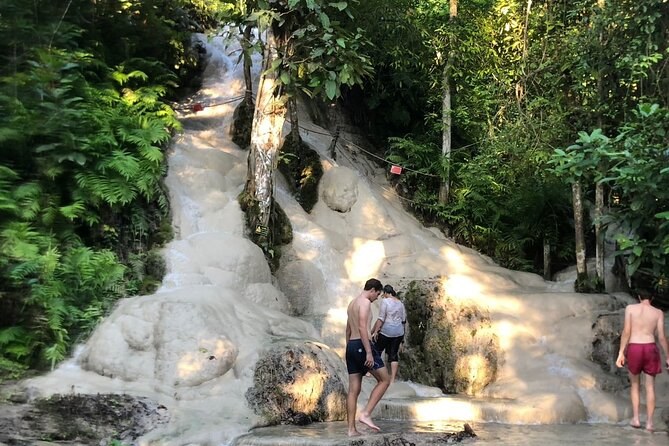
Reach, and the freedom to be slow. A full day — eight to nine hours — buys the temple plus either the upper mountain (the palace, the Hmong village at Doi Pui) or something in a different direction entirely, usually the Bua Thong sticky waterfall about an hour north.
| Half day | Full day | |
|---|---|---|
| Hours | 4–5 | 8–9 |
| On the terrace | 1–2 hours | 1–2 hours |
| Other stops | One temple | Two to four places |
| Vehicle | Shared, on a schedule | Private, waits for you |
| Meals | Rarely included | Lunch usually included |
| Fare | From $17 | From $78 |
| Best for | The temple itself | The mountain and the day |
Note the row that does not change: a full day does not give you longer on the terrace. It gives you more places. If the terrace is what you came for, a half day at the right hour beats a full day at the wrong one.
Is a second temple worth the extra hour?
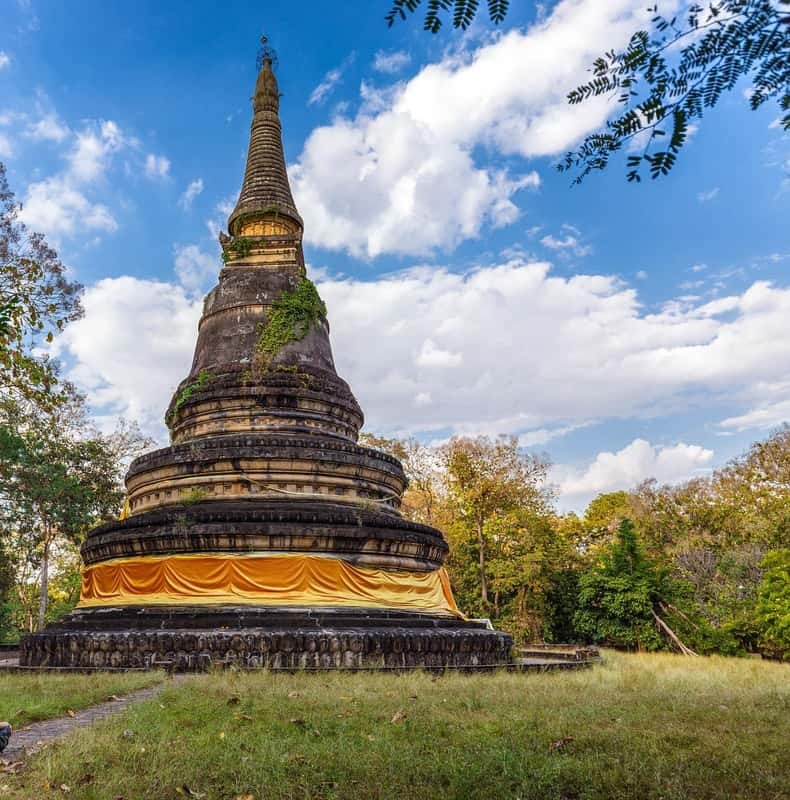
Almost always, and the reason is contrast rather than quantity. The terrace is bright, open, gilded and busy; the two candidates below it are the opposite. Wat Pha Lat sits in forest with a stream through the grounds and moss on the stonework, and Wat Umong is a mound of brick tunnels at the foot of the mountain, dim and cool with Buddha images set into alcoves.
An hour at either turns a single-stop errand into a day with a shape. It also solves the practical problem of what to do with a group that has finished the terrace in forty minutes: on a shared departure the alternative is standing in the car park.
The exception is a three-hour window. With that little time the second temple is the first thing to cut, because the drive up and down is fixed and the terrace is what you came for. Which departures pair which temples is compared across the Doi Suthep guided tours listings, and both temples are described on things to do on Doi Suthep.
What would you drop if you only had three hours?
The second temple, without hesitating. Three hours covers the drive both ways and an hour on the terrace, which is a complete visit if you spend it in the right order: chedi first, halls second, cloister third, viewpoint last.
What you would not drop is the offering set. It costs a few baht from the cloister stall and it converts a walk round a monument into the thing everybody else on the terrace is doing, which is the whole point of being there.
Common questions
How long does a Doi Suthep half day take?
Four to five hours door to door. The road takes 30 to 40 minutes each way, the terrace takes one to two hours, and most departures add a second temple on the way up or down.
Can I visit Doi Suthep and Bhubing Palace in one morning?
Only with a vehicle that waits, so a private car or a chartered songthaew. On a shared departure the schedule does not allow it.
Is there food at the temple?
Stalls at the foot of the staircase, not on the terrace. Sunrise departures usually build a local breakfast into the way down.
What is the best time to leave Chiang Mai?
Half past four for sunrise, or half past three in the afternoon for the evening. Nine in the morning lands you in the busiest two hours of the day.