Doi Suthep Tour Formats Compared: Which One Should You Book?
In this guide
- What are the five ways to visit Doi Suthep?
- How long do you actually get at the temple?
- Is a sunrise departure worth the 4:30 alarm?
- Is the evening departure just the sunrise one in reverse?
- Do you need a guide to understand the temple?
- Which departures include the entrance fees?
- What does a private tour buy that a shared one does not?
- Which format suits a first visit to Chiang Mai?
- Which departure works with small children?
- Who should not book a walking departure?
- How far ahead should you book?
- What does the whole list look like on one screen?
What are the five ways to visit Doi Suthep?
Every departure leaving Chiang Mai for this mountain is one of five shapes, and the fare tells you almost nothing about which. Sorting that out first saves you from the single commonest disappointment here, which is not the temple but the hour you saw it in.
The sunrise departure collects you around five, reaches the terrace while the chanting is under way and hands the rest of the day back by mid-morning. The evening departure does the same in reverse: mid-afternoon pickup, the six o'clock chanting, the city lighting up below, home by half past eight. The walking departure starts at a trailhead behind the university and arrives at the temple on foot, by way of a forest monastery.
The unguided ride is transport and free time: a shared red truck, three stops, no commentary. And the private day pairs the temple with something else entirely — a waterfall, an orchid farm, three more temples — in a vehicle that waits for you.
Those five do genuinely different things. Two of them are about the hour, one is about the arrival, one is about the price and one is about the day. Work out which of those matters most to you and the list of twelve shrinks to three.
How long do you actually get at the temple?
Published stop lengths run from 30 minutes to two hours. That is a fourfold difference, and it is invisible on a price-sorted list, which is why it is the first column in the table below rather than the last.
What each band buys: half an hour is the chedi, one circuit and a photograph from the viewpoint. An hour adds both shrine halls and the cloister at a walk. Ninety minutes lets you buy the offering set and make the three circuits properly. Two hours means you can be sitting on the terrace when the chanting starts, which is what people describe when they get home.
Sort on this column before you sort on price. A four-temple city tour at twice the fare can give you half an hour on the terrace, while a walking departure at the lower end gives you two. What each building on the terrace is, and why an hour disappears fast, is on Wat Phra That Doi Suthep.
There is a floor as well. Below about 45 minutes you cannot climb, walk the circuits, look into a hall and get back to the vehicle without watching the clock. Departures at that end are best understood as a very good photo stop, which is a legitimate thing to buy as long as you know that is what you are buying.
Is a sunrise departure worth the 4:30 alarm?
For most travellers, once, yes. The terrace before seven is a working monastery rather than a viewing platform: chanting under way in the eastern viharn, monks crossing to and from it, offerings being made rather than photographed, mist sitting in the valley and lifting while you watch.
The premium version goes further and includes an alms offering with the food provided, a short guided meditation and an ordained ex-monk as the guide. That is the difference between watching a religious site and being briefly inside its routine, and it is why that departure caps its group in single figures.
The honest counter-argument is the alarm. Collection runs from about half past four depending on where you are staying, and if that is the difference between going and not going, the evening window gives you a cooler, calmer terrace with none of the pain. The straight comparison is in sunrise or evening at Doi Suthep.
Is the evening departure just the sunrise one in reverse?
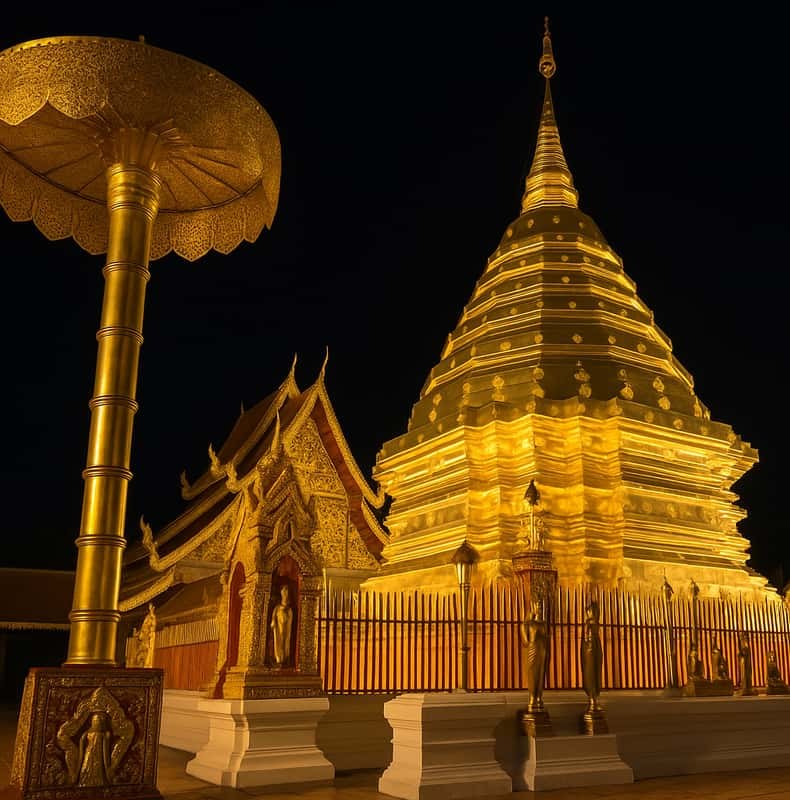
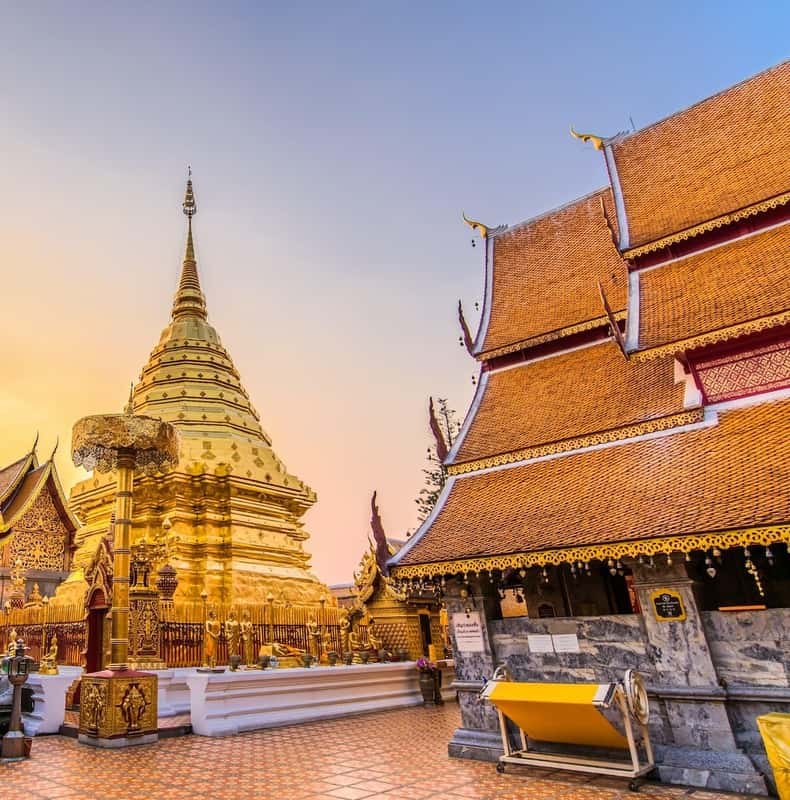
No, and the differences matter more than they sound. Sunrise gives you monastic routine, mist and an empty terrace; evening gives you long gold light, a comfortable temperature and a city turning into a grid of lights below the viewpoint.
The evening trips also pair naturally with a second temple at the bottom of the mountain, because the timing allows it: Wat Umong's brick tunnels work better with daylight at the entrance, so they come first and the terrace comes second. A sunrise trip runs the other way round and fits three temples in before breakfast.
Practically, evening departures are easier to book, run more often and cost slightly less. They are also the sensible choice in April, when the middle of the day on an unshaded terrace at 1,070 metres is nobody's idea of a holiday.
Do you need a guide to understand the temple?
To see it, no. To understand it, mostly yes — and the gap is bigger here than at most attractions, because almost nothing on the terrace is labelled in English and the things worth knowing are behaviours rather than objects.
A guide tells you which direction to walk round the chedi and why, what the offering set is for, when to sit and when to stand, what the bell row is doing, why the forest monastery at Wat Pha Lat was a resting place on the pilgrims' route, and why the white elephant statue near the top of the staircase explains the location of the whole monastery. None of that is discoverable by looking.
What a guide does not buy you is access: there is no skip-the-line, no closed area opened, no separate entrance. The terrace ticket is 30 baht and there is never a queue for it. So the question is genuinely about understanding, not about logistics — which is why the unguided red-truck run is a reasonable choice for anyone who has already read the terrace guide.
Which departures include the entrance fees?
The temple charge is small — 30 baht for foreign visitors, quoted as 50 by some operators — so it rarely decides a booking on its own. What does decide one is whether you want to be counting out cash at a gate at half past five in the morning.
Most guided departures include the temple charge. The walking departures generally do not, because they also attract the national park fee for the trail, and the two together come to about 150 baht a person. The unguided ride includes nothing beyond the ride, which is exactly why it is the cheapest.
The full breakdown of every charge on the mountain, and who collects each one, is in Doi Suthep ticket prices and fees. The column in the table below tells you which fares have already settled it.
What does a private tour buy that a shared one does not?
Three things, and none of them is a better temple. It buys pace: your own vehicle waits, so an hour on the terrace becomes ninety minutes if the chanting has started. It buys reach: with a car that waits you can add Bhubing Palace, the Hmong village at Doi Pui or a waterfall an hour north, none of which fit a shared schedule. And it buys quiet, which matters more than expected on a mountain that receives coach parties.
What it costs is roughly three to six times the shared fare, and for a couple that is real money. For a family of four the arithmetic changes sharply, because most private fares are quoted per person but the vehicle and the guide are being shared four ways rather than two.
The private days here also tend to be full days rather than half days, which is a different commitment from a four-hour departure. What they reach beyond the temple is set out on things to do on Doi Suthep.
Which format suits a first visit to Chiang Mai?
If it is your first day in the city and you want the landmark, take a shared evening or sunrise departure that includes the fees. You will see the temple at its best hour, in company, with the logistics handled and the rest of the day intact.
If it is your third day and you have already done the old-city temples, the walking departure is the better use of a morning: the forest, the monastery in the trees, and then the terrace, which arrives feeling earned rather than delivered.
If you have half a day and want breadth rather than depth, the four-temple city tour takes in Wat Chedi Luang inside the walls before heading up the mountain, and gets you back for lunch. It gives you the least time on the terrace of anything here, and that is the trade you are making.
Which departure works with small children?
The evening departures, comfortably. The temperature is kind, the staircase is optional because the funicular runs alongside, the stop is an hour rather than three, and nobody has to be awake at half past four. Wat Umong's tunnels are the part children remember.
The private day tours are the other good answer, for a different reason: the vehicle waits, so a meltdown costs you twenty minutes rather than the schedule. Two of them pair the temple with the Bua Thong sticky waterfall, where the limestone gives enough grip to walk up the falls, which is the closest thing to a guaranteed hit on this mountain.
What does not work well is a 5 a.m. sunrise departure with a seven-year-old, and one of those listings notes it suits adults more than teenagers. The walking departure is fine for families who walk — several travellers report doing it with young children — though the trail detail on the Monk's Trail is worth reading first.
Who should not book a walking departure?
Anyone for whom uneven ground is a problem. The Monk's Trail is rated easy and it is not steep, but the surface is roots and rock and it is slick after rain from June to October. That is a genuine constraint rather than a warning, and it has a clean solution: ride up instead and the terrace is exactly the same terrace.
Two listings state that their walking programme is not suitable for travellers with mobility impairments, and one sets a minimum age. If either applies, the evening and private departures drive to the door, and the funicular takes you from the car park to the terrace in a minute for 20 baht.
Nothing about the temple itself is inaccessible once you are up there: the terrace is flat, the cloister is covered and the halls are at ground level.
How far ahead should you book?
Between November and February, three to five days for anything that caps its group. The sunrise departure takes nine travellers and the walking departure takes ten, and those are the two that fill. Outside the cool season a day or two is usually enough.
The private days are the exception in the other direction: they are quoted per booking rather than per seat, so availability holds later, but the good guides are spoken for at weekends. Everything here refunds in full up to 24 hours before departure, so an early booking costs you nothing but a reminder in your calendar.
What does the whole list look like on one screen?
Sorted by review volume, with the column that actually decides the day — time on the terrace — second from the left.
| Tour | On the terrace | Total | Fees included | Guide | Group | Fare |
|---|---|---|---|---|---|---|
| Chiang Mai: Doi Suthep and Wat Umong Enchanting Evening Tour | 1 hour | 5 hours | Yes | Yes | — | From $22 |
| Chiang Mai: Doi Suthep, Wat Umong and Pha Lat Sunrise Tour | 2 hours | 4 hours | Yes | Yes | — | From $25 |
| Chiang Mai: Wat Pha Lat & Wat Phra That Doi Suthep Tour | — | 4.5 hours | Yes | Yes | — | From $22 |
| Chiang Mai: Doi Suthep & Wat Pha Lat by Local Red Truck | 1 hour | 4 hours | No | — | — | From $17 |
| Chiang Mai - Doi Suthep Temple & Wat Pha Lat Hike | — | 4 hours | No | Yes | — | From $24 |
| Spiritual Sunrise Wat Doi Suthep, Pha Lat, Alms & Meditation | 1 hour 30 minutes | 5.5 hours | Yes | Yes | Max 9 | From $55 |
| Chiang Mai - Doi Suthep Temple & Wat Pha Lat Hike | 2 hours | 4 hours | No | Yes | Max 10 | From $24 |
| Doi Suthep Temple, Wat Phalad, BauThong Waterfalls Private Tour | 1 hour | 7 to 9 hours | Yes | Yes | Private | From $109 |
| Chiang Mai Best City Tour with Doi Suthep, Pha Lat & Chedi Luang | 30 minutes | 4 to 6 hours | Yes | Yes | Max 10 | From $40 |
| Private Chiang Mai Temple Tour with Doi Suthep and Wat Umong | 1 hour | 9 hours | Yes | Yes | Private | From $137 |
| Chiang Mai Instagram Tour: Most Famous Spots (Private and All-Inclusive) | 45 minutes | 6 to 8 hours | Yes | Yes | Private | From $121 |
| Doi Suthep Temple, Pha Lat Temple, Sticky Waterfall, Orchid farm | 1 hour 30 minutes | 8 to 9 hours | Yes | Yes | Private | From $78 |
Read it left to right rather than by price. If two rows look identical, the tie-breaker is usually the hour of departure, and after that the group cap. The full card for every Doi Suthep guided tours listing sits on Doi Suthep Tours.
Common questions
Which Doi Suthep tour is best overall?
There is no single answer, because the five formats do different jobs. For a first visit, an evening departure with the fees included; for the photographs, a sunrise departure; for the arrival, the Monk's Trail walk.
Is the temple free if I go on my own?
No. Foreign visitors pay 30 baht at the terrace, and some operators quote 50. Thai nationals are not charged. The funicular is a separate 20 baht each way.
Do I need a tour to walk the Monk's Trail?
No, but the trailhead is unsigned and the national park now charges 100 baht to walk it. A guided walk handles the route and tells you what the forest monastery is.
Can I combine Doi Suthep with somewhere else in one day?
Yes, on the private days. Two pair the temple with the Bua Thong waterfall, and one takes in four temples across the city and the mountain.