Doi Suthep at Sunrise vs in the Evening: Which Visit Is Right for You?
Short answer. Sunrise gives you monks chanting, mist in the valley and an empty terrace, at the cost of a 4:30 alarm. Evening gives you cool air, gold light and Chiang Mai lit up below, and you can sleep in. If the photographs matter most, go at dawn. If the day matters more than the morning, go in the evening.
Seven of the departures leaving Chiang Mai for the mountain are one or the other, the fares are within a few dollars, and travellers who book the wrong one are rarely disappointed by the temple — they are disappointed by the hour. This is the real decision at Doi Suthep, and it is worth ten minutes before you book. The hours themselves are on plan your visit.
The short answer, by traveller
- Photographers: sunrise, unless it is March.
- Families with young children: evening. Nobody enjoys a 4:30 alarm at seven years old.
- Anyone travelling in April: evening, for the heat as much as the light.
- First visit to Thailand: sunrise, for the chanting and the alms.
- One free evening in Chiang Mai: evening, obviously.
Side by side
| Sunrise | Evening | |
|---|---|---|
| Pickup | 04:30–05:15 | 15:30–16:30 |
| On the terrace | 05:45–07:30 | 17:30–19:30 |
| Crowds | Almost none | Thinning as you arrive |
| Temperature | Cold in December, cool all year | Comfortable year round |
| Monastic life | Chanting, alms, monks on the path | Evening chanting around 18:00 |
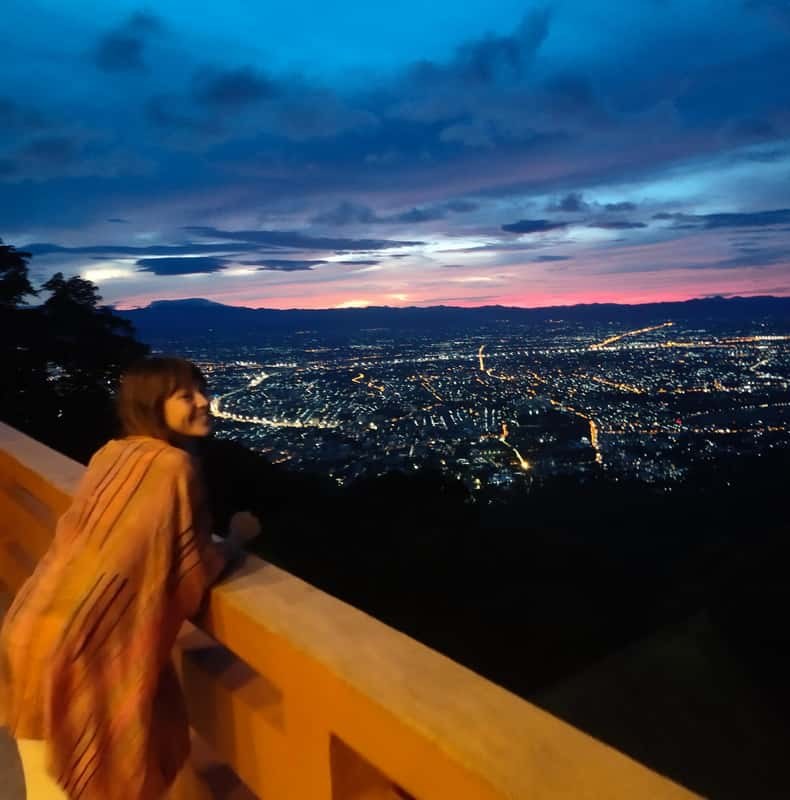
| The view | Mist in the valley, sun behind the city | City lights coming on |
| Typical fare | From $25 | From $22 |
| Rest of your day | Free from mid-morning | Gone by early afternoon |
The case for sunrise
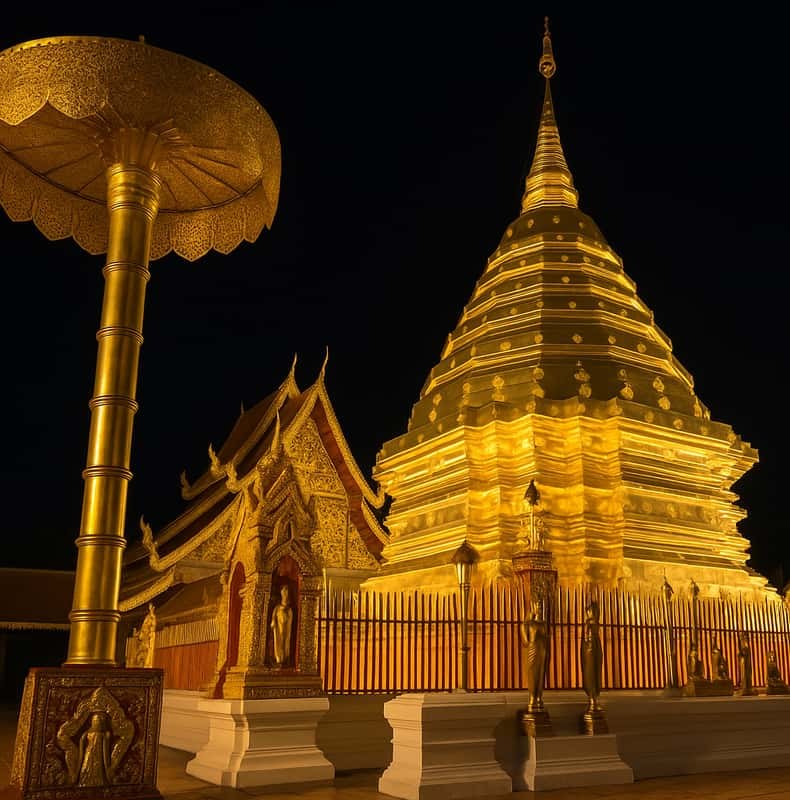
The terrace before seven is a different building. The chanting is under way in the eastern viharn, monks cross the terrace on their way to and from it, offerings are being made rather than photographed, and the gilding takes low orange light in a way it never does at noon. Mist sits in the valley and lifts while you watch.
The premium version adds the alms offering and a first meditation with an ordained ex-monk as the guide, which is the difference between watching a religious site and being briefly inside its routine. Groups are small at that hour because almost nobody else is awake.
The case for evening
From five o'clock the coaches leave, the air drops several degrees and the light goes long and gold. By six the chanting has begun again; by half past the lamps are lit and the city below is coming on square by square. It is the most comfortable version of the visit by a distance, and in the hot season that is not a small thing.
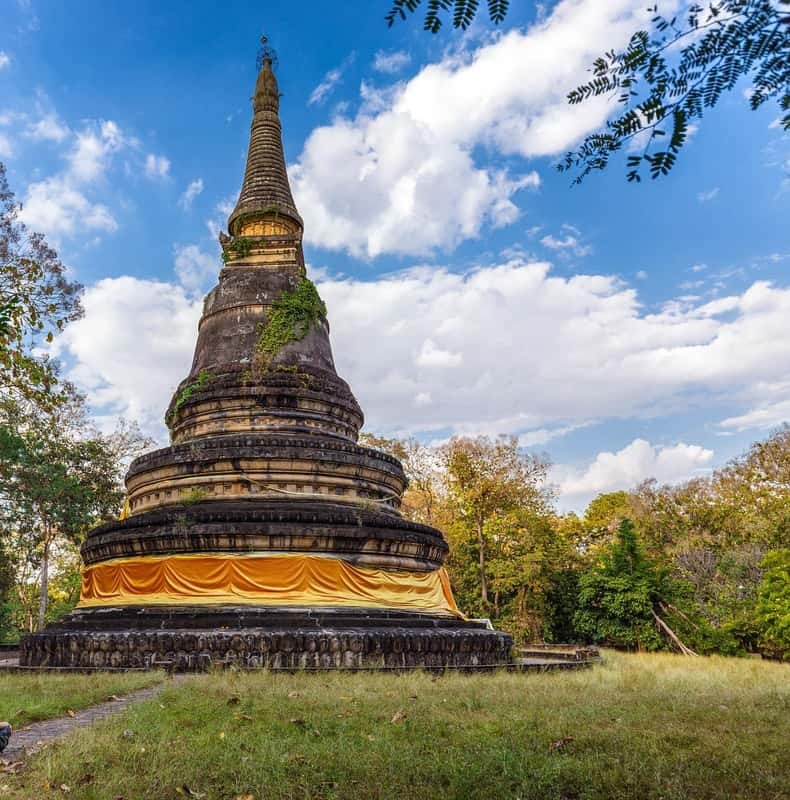
Evening departures also pair naturally with a second temple at the bottom of the mountain, so the trip has a shape rather than being a single stop. Wat Umong's tunnels in particular work better before dark than after it.
What each one costs you
Fares are close enough that price should not decide this. What differs is the rest of your day: a sunrise trip hands the morning back by half past ten, and an evening trip takes the afternoon. If you are in Chiang Mai for two days, that is the deciding argument.
Book the sunrise ones earlier. They cap at nine and ten travellers and fill first in the cool season, while the evening departures run larger and more often. Three to five days ahead is enough from November to February.
Doing both
It is not as strange as it sounds. The two visits share almost nothing: one is monastic routine and mist, the other is a lit terrace above a lit city. Travellers staying a week sometimes take the sunrise walk up the Monk's Trail and come back on an evening departure with a different operator.
If you only do one thing twice in Chiang Mai, this is a reasonable candidate. The walk that pairs with a sunrise is described on the Monk's Trail.
What the weather does to the choice
| Season | Sunrise | Evening |
|---|---|---|
| Nov–Feb | Cold and clear; the best mist of the year | Cool, sharp city lights |
| Mar–Apr | Smoke can hide the valley | Smoke, plus heat until late |
| May–Jul | Clean air after rain, dramatic skies | Storm risk late afternoon |
| Aug–Oct | Mist and cloud, atmospheric | Wet, but the terrace has cover |
The full month-by-month picture, including the festival dates that fill the terrace, is in Doi Suthep month by month.
The verdict
If you can only do one and you can face the alarm, go at dawn: it is the version of Doi Suthep that people describe years later. If the alarm is the difference between going and not going, go in the evening — a comfortable visit you actually make beats a spectacular one you skip. Either way, avoid eleven in the morning.
What each window actually contains
A sunrise departure is not simply an early version of the same trip. The terrace is open before the ticket desk is staffed, the chanting is under way when you arrive rather than scheduled around you, and the alms round happens on the path rather than as a set piece. On the premium version an ordained ex-monk leads a first meditation, and the group is capped in single figures because that is who is awake.
An evening departure runs the other way round. You arrive as the site is emptying, the six o'clock chanting starts while you are on the terrace, and the sequence ends with the valley lighting up beneath the viewpoint. Both include a second temple lower down, so the trip has a shape. What each building on the terrace is doing at those hours is set out on Wat Phra That Doi Suthep.
Getting back down, which is the real difference
At seven in the morning the mountain road is quiet and every songthaew at the bottom is heading into town. At eight at night it is dark, the shared trucks have thinned out, and what was a 40-baht ride becomes a negotiation. That asymmetry is the practical argument for a guided evening departure and against going up alone after five.
If you would rather go independently anyway, the fares and the last realistic departure times are set out on plan your visit and in how to visit Doi Suthep.
A quicker way to settle it than a table
- Would you get up at 4:30 for a photograph? If yes, sunrise. If you hesitated, the hesitation is your answer.
- What else is your day doing? A sunrise trip is finished by half past ten and leaves the day intact. An evening trip takes the afternoon and gives you the morning.
If both answers point the same way, book it. If they conflict, the walking departures sit between the two: they leave at a civilised hour and still reach the terrace before the coaches, and they are described on the Monk's Trail.
Decision made? Both windows, and everything between them, are compared on Doi Suthep Tours.
Tours that fit this trip
Chosen for what this post covers, not for what sells.