Facts About Doi Suthep That Surprise First-Time Visitors
Short answer. An elephant chose the site, the road was built by volunteers rather than the state, nobody agrees how many steps the staircase has, the temple is not a UNESCO site, and the national park around it only started charging in October 2025. Ten things that change how you plan the day.
Doi Suthep is the most visited Buddhist site in northern Thailand, and most of what gets repeated about it is either wrong or the least interesting true thing available. These are the facts that surprised us while putting the practical pages together, each one with a consequence for your visit. The full history sits on Wat Phra That Doi Suthep.
An elephant picked the spot
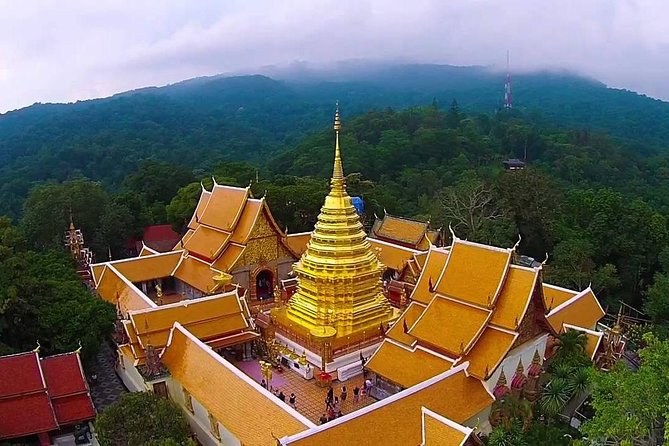
When a relic believed to be the Buddha's shoulder bone reached Lan Na in the 1380s, King Kue Na did not choose where to enshrine it. He put it on the back of a white elephant and let the animal walk. It climbed the mountain, trumpeted three times, turned round three times, knelt and died — and the chedi was built on that spot in 1383.
The consequence is the switchbacks. The temple is not where it is for any strategic or practical reason, which is why the road that reaches it takes 15 kilometres to cover eight as the crow flies.
There was no road at all until 1935
For five and a half centuries the only way up was a footpath, five hours or more each way. The road was built in 1935 by volunteers organised by the northern monk Kruba Srivichai, who raised labour from villages across the region rather than money from the state.
The road took months, not years. That is why Kruba Srivichai's monument still gets fresh flowers at the foot of the climb, and why one of the sunrise departures stops there on the way up.
Nobody agrees how many steps there are
The naga staircase is counted at 309 by Wikipedia and at 306 by two of the tour operators here. Both are honest; the number depends on which step you call the first. What is not in dispute is that the balustrade is the longest of its kind in Thailand.
It is not a UNESCO World Heritage Site
Plenty of travel writing says otherwise. Chiang Mai's monuments sit on Thailand's tentative list, and the temple itself is not inscribed. It does not need the label: it is still the site every visitor to the north is told they have to see.
The mountain charges, and only since October 2025
Doi Suthep-Pui National Park introduced an entrance fee on 1 October 2025: 100 baht for a foreign adult, 50 for a child. It applies to the Pha Lat Nature Trail, Huai Kaew Waterfall, Doi Pui and Suan Son — not to reaching either temple by road. Most guidebooks on the shelf predate it entirely.
The practical effect is that walking up now costs more than riding up. Where exactly the fee applies is mapped on the national park page.
The forest path is marked with monks' robes
The Monk's Trail is waymarked with strips of orange cloth tied round trees at eye height, left by monks so the route could be followed before anyone thought of signposting it. They are still the only markers, and they are still the reason people find the way. The walk is described in full on the Monk's Trail.
The relic has never been on display
It is sealed inside the chedi and always has been. Visitors who go looking for it in the shrine halls are looking in the wrong place — the whole point of walking three clockwise circuits round the stupa is that the stupa is the object.
Thai visitors pay nothing
The 30-baht terrace charge applies to foreign visitors only. If a Thai friend tells you the temple is free, they are not misremembering; they have simply never been asked. The figures, and the operators who quote 50 instead, are in the ticket prices guide.
The temperature drops as you climb
The terrace sits about 1,070 metres above sea level and runs several degrees cooler than the valley floor, and the summit village at Doi Pui, another 600 metres up, is cooler again. In December a sunrise visit is genuinely cold. In April it is the most comfortable place within an hour of the city.
The best two hours are the ones nobody books
| Belief | What is actually true |
|---|---|
| Go in the morning to beat the crowds | Mid-morning is the busiest window of the day |
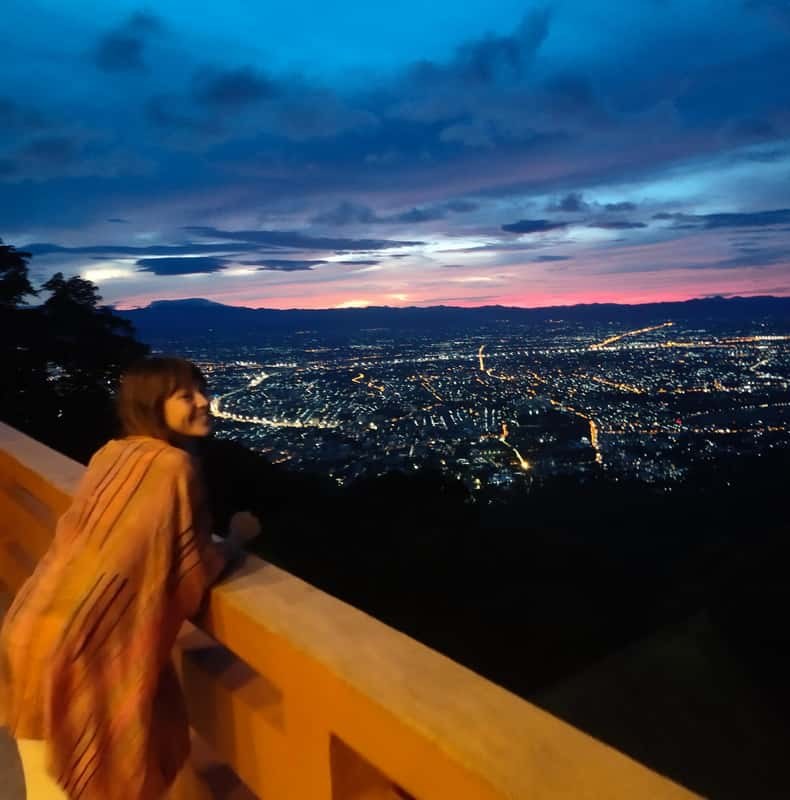
| The view is the reason to go | In March the view may not exist; the chanting always does |
| The stairs are the hard part | 309 shallow steps, or a 20-baht cable car |
| It is free to walk up the trail | Not since October 2025 |
| An hour is plenty | An hour sees it; two hours means you were there for something |
Sunrise and evening are the two windows that change the visit, and choosing between them is the subject of sunrise or evening at Doi Suthep.
What to do with all this
- Pick an hour, not just a date. It is the single decision that matters most.
- Carry cash in small notes for the terrace, the funicular and the trail.
- Give the chedi its three circuits before you go looking for the view.
- If you are walking up, budget the park fee; if you are riding, forget it.
There is a cable car, and hardly anyone mentions it
A funicular runs up the hillside beside the staircase for 20 baht each way and arrives on the terrace itself. It is the reason the temple works for visitors who cannot manage 309 steps, and it takes about a minute. Guides wait at the top for whoever uses it, so groups do not get split.
Almost no travel writing about Doi Suthep mentions it at all, which leaves people assuming the stairs are the only way in. They are not, and the practical detail is on plan your visit.
You can ask a monk anything, at set hours
The temple runs an open question-and-answer session on the terrace, in English, at advertised times. Anyone can sit down. It is not a performance for visitors and it is not a recruitment exercise; it exists because questions were being asked anyway and this was tidier than answering them one at a time.
It is the single best-value thing on the mountain and it costs nothing. Where it sits among everything else on the terrace is set out on Wat Phra That Doi Suthep.
The temple is not the only thing on the mountain road
The road does not stop at the temple. It carries on to Bhubing Palace and ends at a Hmong village at 1,685 metres, and the forest on either side is a national park with waterfalls and trails in it. Most visitors go up, see one building and come down again.
Whether the rest is worth your afternoon depends entirely on whether your vehicle waits, which is the argument made in full on things to do on Doi Suthep and again in how to visit Doi Suthep.
Curiosity satisfied? Find the departure that gets you there at the right hour on Doi Suthep Tours.
Tours that fit this trip
Chosen for what this post covers, not for what sells.