How to Visit Doi Suthep: Tickets, Hours, Tours and Everything You Need to Know
Short answer. Wat Phra That Doi Suthep is 15 km west of Chiang Mai, the gate is open 5 a.m. to 9 p.m. every day, and the terrace costs foreign visitors 30 baht plus 20 for the funicular. Getting up the mountain is the real decision: a shared songthaew, a rented scooter, or a guided departure that fixes the hour you arrive. The visitors who enjoy it most are the ones on the terrace before seven or after five.
Almost everything written about visiting Doi Suthep gives you one set of opening hours, and the sets contradict each other. That is the first thing to sort out, because it decides whether you see the temple at its best or at its busiest. This post covers the hours, the money, the climb, the drive and how to choose between the departures leaving Chiang Mai every morning. Every tour compared on Doi Suthep Tours refunds in full at 24 hours, which matters on a mountain where the weather changes fast.
Quick facts before you plan anything
| Open | 5 a.m. – 9 p.m., seven days a week |
| Where | Suthep, Mueang Chiang Mai District, Chiang Mai 50200 |
| From the old city | About 15 km · 30–40 minutes each way |
| Terrace fee | THB 30 for foreign visitors, cash |
| Funicular | THB 20 each way, beside the staircase |
| Staircase | 309 steps, 5–10 minutes |
| Time needed | 1–2 hours on the terrace |
| Founded | 1383, under King Kue Na of Lan Na |
The hours nobody agrees on, and which one to trust
Published figures for the temple run from 6 a.m. to 6 p.m. through to 6 a.m. to 8 p.m. The Google listing says 5 a.m. to 9 p.m., and that is the one that matches what actually happens: sunrise departures collect travellers at five and are inside for the dawn chanting, and evening departures drop off in the city at half past eight.
The resolution is simple once you separate the gate from the desk. The gate keeps the long hours. The ticket desk and the funicular keep shorter ones, so an early arrival may walk straight in and a late one will find the cable car stopped and the stairs lit. The full timetable, including the chanting hours, is on plan your visit.
What it costs, and what it does not
The temple charges foreign visitors 30 baht at the terrace. Some tour listings quote 50 instead, so carry a little more than you expect to need. Thai nationals are not charged at all, which is why a Thai friend may tell you it is free.
The charge that surprises people is not the temple's. Since 1 October 2025, Doi Suthep-Pui National Park has charged foreign adults 100 baht and children 50 for the Pha Lat Nature Trail, Huai Kaew Waterfall, Doi Pui and Suan Son. Reaching either temple by the main road costs nothing extra. Every charge on the mountain is broken down in the Doi Suthep ticket prices guide.
Getting there: four ways, and what each one costs you
- Shared red songthaew. From Chang Phuak Gate or the zoo end of Huay Kaew Road, roughly 40 to 50 baht a person each way when the truck is full. Cheapest, and the return is the leg to arrange before you set off.
- Rented scooter. Half an hour of switchbacks. Fine in the dry season with a licence and some experience; not the road to learn on in August.
- Grab or a chartered taxi. The middle option. Agree the waiting time and the total before you leave, in baht.
- A guided departure. Fixes the hour you arrive, handles the fees on several fares, and puts a driver at the bottom when you come down.
The hour you arrive is worth more than the money you save. A songthaew at eleven in the morning drops you into the busiest two hours of the day; a guided departure at five or at five in the afternoon does not. Every route is costed in going to Doi Suthep independently.
The staircase, and the cable car beside it
The naga staircase is the classic arrival: 309 steps between two serpent balustrades, five to ten unhurried minutes, shaded most of the way and shallower underfoot than the photographs suggest. Wikipedia counts 309, two operators count 306, and the difference is where you decide the first step is.
The funicular runs alongside for 20 baht each way and arrives on the terrace itself. It is the reason the temple works for visitors who would find stairs hard, and guides wait at the top for whoever takes it. Stairs up and cable car down is what most people settle on.
How long to allow, and what fills it
An hour covers the chedi, a walk round the cloister and the viewpoint. Ninety minutes lets you buy a lotus and make the three clockwise circuits properly. Two hours means you can sit through the chanting, which is what people describe when they get home rather than the view.
Most departures add a second temple to the day, and the two candidates are very different. Wat Pha Lat sits in forest below the summit with a stream running through the grounds. Wat Umong is a mound of brick tunnels at the foot of the mountain, cool and dim, and it is the one that works best in the afternoon heat.
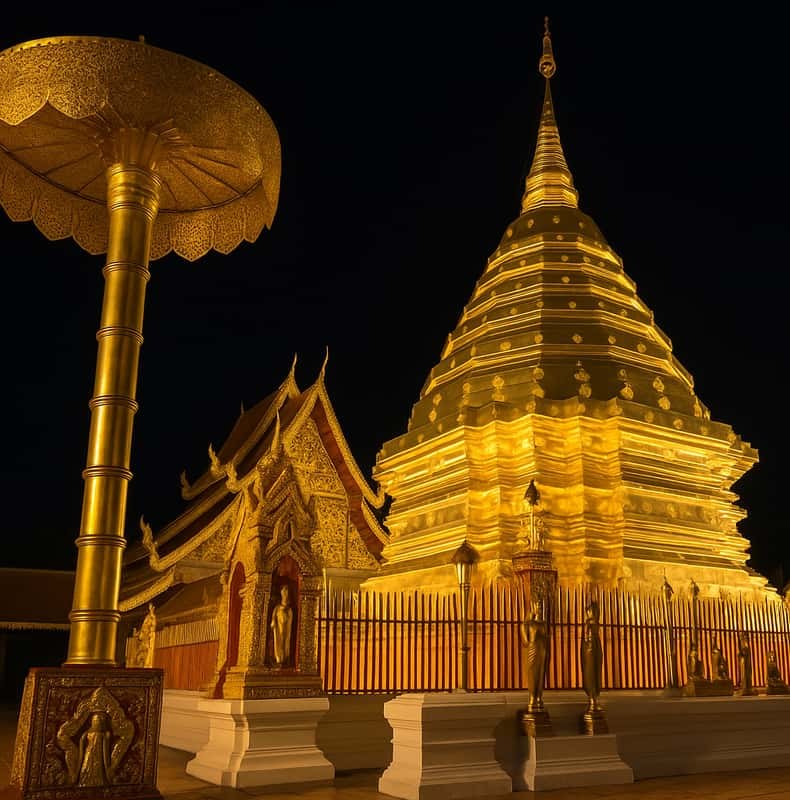
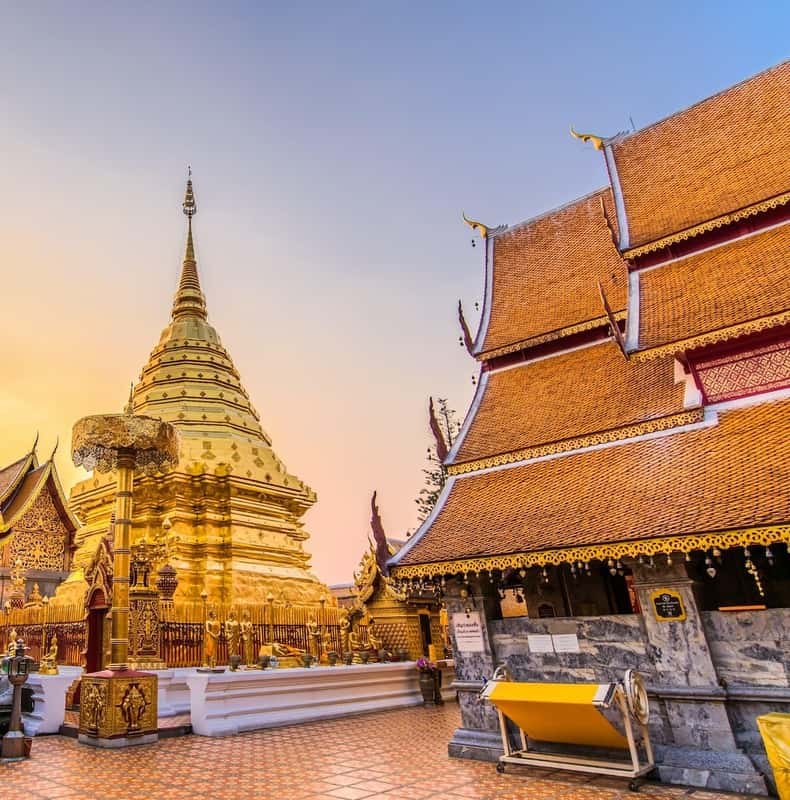
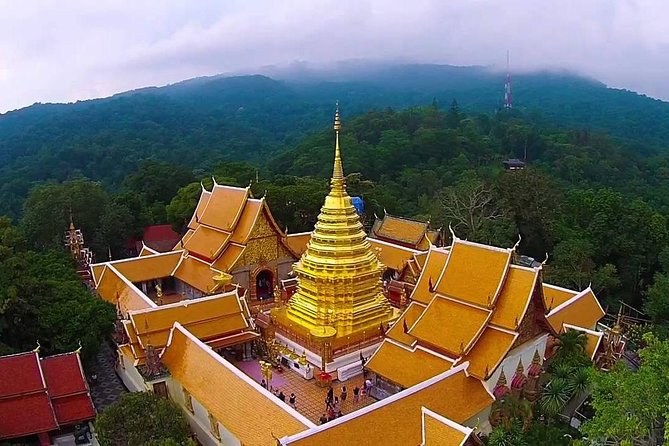
What is on the terrace, building by building, is set out on Wat Phra That Doi Suthep. If you have half a day rather than two hours, the road continues past the temple to Bhubing Palace and the Hmong village at Doi Pui — both covered on things to do on Doi Suthep.
What to wear, and what to carry
Shoulders and knees covered, for everyone. Sarongs are lent at the gate, but arriving dressed for a temple saves you the queue. Take a light layer as well: the terrace sits about 1,070 metres up and runs several degrees below the city, and a December sunrise is cold enough to notice.
Bring small notes. The terrace fee, the funicular and the stalls are all cash, and change is limited before about eight in the morning. Two hundred baht in twenties and fifties covers a visit comfortably.
Sunrise, midday or evening
| When | What it is like | Trade-off |
|---|---|---|
| 05:30–07:00 | Chanting, mist in the valley, nearly empty | A 4:30 alarm |
| 07:00–10:00 | Filling up, still comfortable | The light is already high |
| 10:00–15:00 | Coaches, queues, full sun | The busiest and hottest |
| 17:00–20:00 | Cool, gold, city lights below | No sunrise over the valley |
Which of the two good windows suits you is worth ten minutes of thought, and it is the whole subject of sunrise or evening at Doi Suthep.
Three things first-time visitors get wrong
- Treating the terrace as a viewpoint. The view is the smaller half. The chedi, the circuits and the chanting are what the place is for.
- Arriving at eleven. It is the one hour that makes a quiet temple feel like a car park, and it is entirely avoidable.
- Not planning the way down. Getting up is easy at any hour. Getting back at eight in the evening, without a driver, is the part that goes wrong.
Booking, cancelling and changing your mind
There is no advance ticket for the temple itself. What books out is the small-group departures, which cap at nine and ten travellers, so give those three to five days in the cool season. Every departure refunds in full up to 24 hours before the start time, and no refund is given inside that window — set a reminder the day before and the decision stays yours.
Questions people ask before they go
What is the cheapest way to see Doi Suthep?
A shared red songthaew from Chang Phuak Gate, at roughly 40 to 50 baht a person each way, plus the 30-baht terrace fee. The cheapest guided option adds a driver who waits and two extra stops for a little more.
How early do sunrise tours collect you?
Between 4:30 and 5:15 in the morning, depending on where you are staying. That puts you on the terrace for the dawn chanting and back in the city by mid-morning.
Do I need to book the temple in advance?
No. The temple sells its terrace ticket at the gate and there is nothing to reserve. What sells out is the small-group departures, which cap at nine and ten travellers.
Hours settled and money counted? Pick the departure that puts you on the terrace at the right hour on Doi Suthep Tours.
Tours that fit this trip
Chosen for what this post covers, not for what sells.